Monday, April 13, 2015

Separating Gradebooks and Report Cards

I recently had the opportunity to engage in a two-day workshop with Dr. Tom Guskey of the University of Kentucky. His session, “Leading the Way to More Effective Grading and Reporting for All Students,” urged participants to consider three guiding questions when designing their grading and reporting systems:
  • Why do we use report cards and assign grades to students’ work?
  • Ideally, what purposes should report cards or grades serve?
  • What elements should teachers use in determining students grades?
  • With these questions in mind, Dr. Guskey identified potential purposes and audiences for a comprehensive grading system. This graphic summarizes those elements.


Once upon a time, before technology made grading and communicating about grades more efficient, those three reports were unique. The gradebook was the teacher’s domain. It was where she recorded progress and anecdotal information. Students and parents did not have access to it which gave the teacher a great deal more autonomy in using professional judgment when putting grades on the report card. Now that our gradebooks are public, mathematic algorithms override professional judgment to determine the grade on the report card. Efficiency has merged these three different reports. And maybe that’s not a good thing.

Let me be clear here: I am not advocating for eliminating online gradebooks.  They definitely serve purpose of reporting learning progress. The online gradebook holds all three interested parties – students, teachers, and families – accountable. But – here’s a crazy thought – what if the gradebook did not have a current grade? What if it only did what it was supposed to do: show progress?

On several occasions throughout the conference, Dr. Guskey emphasized the importance of informed professional judgment. We all know the perils of averaging grades. Students who take longer to master concepts and skills are penalized by earlier grades. Not to mention, most systems use the antiquated 100-point grading scale where failing grades are weighted 6 times those of passing grades. In our current system, teachers are challenged to manipulate the gradebook to make it reflect what they know is true about their students’ learning, and students play the game of school, calculating how many points they need to earn a grade. Moving to rubrics, a 4-point scale, and removing the grade from the online grade book may be a step in the right direction. The report card could then be the opportunity for the teacher to share the final professional judgment of the student’s learning during that grading period.


It’s a radical idea. It would require a fundamental shift in practice. It would involve a lot of education for all of the stakeholders about its purpose as well as the logistics. And it just might be worth it. 

Monday, February 9, 2015

Can We Afford NOT to Have Mentors?

The first year of teaching. Although it was almost a quarter of a century ago, I remember it clearly. My eighth grade students in a small city in Wisconsin graciously removed my rose-colored glasses in short order. My mentor, Jane Thompson, was my savior. She wiped away my tears of frustration while helping me develop my own teaching style. She loved the energy of middle school kids, even when they were at their hormonally instable worst and she passed this on to me. When I later moved on to other districts, I was once again blessed with amazing mentors, formal and informal. Without their support, I am certain I would not have survived, much less thrived.

Dr. Debra Pitton, Education Department Chair at Gustavus Adolphus College, was the keynote presenter at the Minnesota ASCD New Teacher-Mentor Summit in St. Paul last Thursday. Pitton, author of Mentoring Novice Teachers: Fostering a Dialogue, led the 150 mentors, mentees, and district leaders through a series of exercises and dialogues designed to build rapport and establish trust. She cited the work of James Comer (2004) and Roland Barth (2006) that recognize the significant impact that relationships among adults in a school has on student achievement.

Following the keynote, attendees broke into job-alike groups. The new teachers collaborated to discuss their struggles and successes. They learned about their own communication styles and how that may impact how they elicit and receive feedback. Mentors reflected with their peers on a similar topic. District leaders had the chance to discuss considerations for developing effective mentor programs. It was surprising the number of Minnesota districts who currently have no formal new teacher induction/mentoring program!

Mentoring new teachers is a key to retaining them, particularly as a teacher shortage looms.  The National Commission on Teaching and America’s Future (2007) reports that 20% of teachers leave the classroom within three years; in urban districts, close to 50% leave in their first five years of teaching. The National Center for Education Statistics has discovered a correlation between the level of support for new teachers and their likelihood of staying beyond the first year. They recommend districts create mentoring programs for the first two years of teachers’ careers.

Under the leadership of Diane Rundquist, High Potential and Teacher Induction Coordinator, Minnetonka Public Schools has developed a three-year support model for its new teachers. In the first year, teachers new to Minnetonka, regardless of their years of experience, work with a 1:1 mentor weekly. Additionally, they connect with other teachers new to Minnetonka through district-level seminars and in their Schoology group. Second year teachers have the opportunity to select a content mentor, someone who has experience and expertise in a self-identified area of growth for the new teacher. They may observe their mentor teach and process with them throughout the year. Finally, in the third year, teachers work with National Board Certified teachers who are their reflection mentors. It is a foundation for becoming reflective teachers and encourages them to perhaps consider the National Board Certification process.


Supporting new teachers is not just something nice to do if you can find the time and resources. It is a fundamental obligation. As we look toward the future of our profession, the role of mentors, both formal and informal, is critical.

Monday, February 2, 2015

EdCamp: Policy Edition

This past Saturday, Minnesota-ASCD, the state affiliate of ASCD, sponsored EdCamp Policy Edition. I have to admit: when this was first proposed I was skeptical. Is having a focus to an EdCamp antithetical to the EdCamp philosophy? (If you’re not familiar with the EdCamp philosophy, this short video highlight’s Minnetonka’s 2014 EdCamp.) And I had other concerns, too. Would people really come to an EdCamp with a policy focus? Would it end up being a day of complaining or a day of problem-solving? As it turns out, all my concerns were for naught.

At an EdCamp, the right people are in the room.  The participants ranged from superintendents and district administrators to classroom teachers to education consultants to higher education administrators. We even had a grandparent of Minnesota students with no other affiliation to the education field!

The topics ranged from teacher preparation, licensure, and tenure to the school calendar to empowering educator voice in decision making. (For a full list of topics, click here.) The challenge of the day was picking and choosing which session to attend! And while there certainly was an opportunity to air grievances, the focus was definitely solution-oriented. In fact, at the end of the day during the Smack Down, the chance for individuals to share their most impactful learning of the day, the conversation became about the next steps. Everyone present was ready to act!


EdCamps have become popular because of the opportunities for self-directed professional growth. This policy-based EdCamp offered two additional benefits. First, it was problem-solving. Participants walked away with concrete ideas of how to advance their work. Communications to legislators were drafted collaboratively! The second benefit was the networking opportunities. Committed educators from diverse backgrounds connected in ways that would not have been possible in any other format. This model of professional development and connecting has great promise for moving education priorities forward.

Monday, January 26, 2015

Observation Bias?

At a recent networking event for teacher evaluation leaders, we were presented with a provocative research article about classroom observations as the basis for teacher evaluation. One of their contentions is that there is an inherent bias in the Charlotte Danielson rubrics against teachers working with underperforming students. The authors write, “…a   rating of ‘distinguished’ on questioning and discussion techniques requires the teacher’s questions to consistently provide high cognitive challenge with adequate time for students to respond, and requires that students formulate many questions during discussion. Intuitively, the teacher with a greater share of students who are challenging to teach is going to have a tougher time performing well under this rubric than the teacher in the gifted and talented classroom.”

My initial response to this was one of disagreement. As a former instructional coach and Charlotte Danielson fan, I wanted to argue that good teaching is good teaching. For years we’ve argued that the rubrics apply equally in all settings: PE classrooms, special education classrooms, basic skills classrooms, and honors classrooms. It’s been a foundation of both our Q-Comp program as well as our teacher evaluation program for over a decade. Despite my initial dismissal of the article, I continued reading. And then the authors shared the data.


The disproportionate ratings gave me pause to reflect on my own teaching experiences. When I returned to teaching after spending three-and-a-half years as an instructional coach, I asked my principal to assign me the students with the greatest needs. It was rewarding. And challenging. And exhausting. How would I have been rated that year?  I loved the kids I taught, believed in them, and still they did not engage in the learning in the same year as my students who had historically been successful in school.

The implications of this research are huge. As the stakes associated with teacher evaluation increase, teachers may be less inclined to work with students who need the most support. Currently, there’s legislation in discussion to connect lay-offs with teacher evaluation. While 35% of teacher evaluation is now, by statute, based on student achievement measures, the remainder is likely based on administrative observation.

An additional implication of this research is its effect on the feedback teachers receive on their classes. In most cases, teachers choose which of their classes will be the subject of the observation. In a growth model, such as the Q-Comp instructional coach model, teachers will frequently invite their colleague into their most challenging class. The second set of eyes provides them with insights that lead them to reflect on their practice and consider alternatives to their current methodologies. If, however, the observations are high-stakes, and if the research is correct, teachers will be less likely to invite their administrators into their most challenging classes, perhaps bypassing the opportunity to get feedback that would ultimately help their students.

If the research is valid, how might evaluators level the playing field for teachers? The authors of the research study suggest a complex statistical analysis of student demographics and performance to create a value-add formula that would adjust for these difference. This may be oversolving the problem, and may actually lead to less transparency and additional issues. A simpler solution may be to simply raise awareness to this potential bias. The simple awareness will influence the administrators’ assessments. This also begs additional emphasis on the pre-observation and post-observation conferences. Teachers need to have the opportunity to educate the evaluator on the composition of their classes and to articulate the strategies they are employing to meet the needs of those students.

To be sure, the research presented in this article wasn’t perfect. It was a small sample size, and the authors seem to have some biases of their own. And even with those flaws, it should give pause to all of those involved in high-stakes observations.


Tuesday, January 20, 2015

Personalizing Online Feedback

For the past few weeks, the topic of feedback has come up again and again. How important is feedback? Who should be giving the feedback? Under what circumstances? What should the feedback look like and sound like? How should feedback change when it is delivered electronically?

As teachers our lives revolve around giving feedback. We give feedback to our students informally when we smile at a response while nodding our heads. We give feedback to students formally when we identify the strengths and areas for growth in an essay. We see the impact of our feedback when it delivered well: “light bulb” moments, improved writing, persisting in a challenge. We have also seen the impact of our feedback when it was delivered poorly: tears, frustration, giving up. So we got better at giving feedback. We learned how to personalize the message to each student. When we have to give students negative feedback – which we do – we know how to couch it with support. But, as more and more of our assessments are given and feedback is received digitally, how do we have to modify it?

Research shows that tone and interpretation of online communications are entirely dependent upon the mood of the reader. Yikes! Knowing that we can’t possibly know, predict, or control the mood of the reader, how can we effectively communicate with our students about their learning progress?

Michelle Gill, Vice President of Professional Learning for PLS 3rd Learning, an organization dedicated to helping teachers develop and facilitate online learning, suggests a few things.
  • While brevity is often glorified, particularly in email communications, when giving feedback it can have detrimental effects. The more you can explain your feedback, the better. Another option is to use an online voice recorder lie Vocaroo to record your feedback orally. This can also personalize the message as it literally has your voice.
  • Read the feedback aloud before you send it. Can you read it in an angry tone?
  • Be cautious about the use of an exclamation point. The exclamation point can easily be misinterpreted. Instead, use vivid language to express your enthusiasm. Gill rarely uses them in electronic communications.
  • Get feedback on your virtual voice. Ask a colleague – or, for the truly brave, your students – to analyze your communications for tone and voice. Your goal with your online communications is friendly, supportive, and open to further communication.

While these tips may not change the mood of the recipient of the feedback, they may mitigate it. Just as we developed skills in giving feedback to students in-person, we’ll develop skills in the online platform. 

Monday, January 5, 2015

Survey Says...

In my house, Family Feud was an after school staple. I loved watching the contestants try to read the minds of the surveyed viewers. Of course, now, as an adult with survey writing and analytic experience, I have all sorts of questions. How were respondents selected? Was it determined by geography? Age? Was it conducted over the phone? Through the mail? Was it anonymous? All of these demographics impact the results.

While we’ve been using surveys in education to garner feedback on educational programs for many years, we haven’t surveyed students in any systemic way to learn about their perceptions about teachers. The new Minnesota teacher evaluation law that went into effect in July requires that teachers be evaluated on student engagement. As a result, teachers are receiving feedback from students – often in the form of anonymous surveys. And inevitably, for even the teachers with great reputations and relationships with students and families, a student – or a few students – gives honest feedback that may be difficult to read. How we respond to this feedback is the key. In my conversations with teachers, I've landed on a few recommendations.

First, when examining the data, look at the trends holistically. What big picture does the aggregated data paint? What are the identified strengths? How can those strengths be leveraged? In a growth model, working from strengths is really powerful.

Then dig in. When dis-aggregating the data, look at it through different filters: class, gender, ethnic demographics. What trends do you notice within these filters? If unfavorable data is discovered, dig even deeper. Some platforms allow the user to browse through individual survey responses. This can provide greater insights into the responses. Caution: avoid the temptation to try to determine the source of the response. This can lead to dismissing the feedback. Reflect on the feedback and how it aligns with your self-perceptions. If it doesn't align with how you see yourself, reflect on what actions may have led to this specific feedback.

Finally, choose one growth area. Focus on specific strategies that could improve student engagement. We use Robert Marzano’s book The Highly Engaged Classroom as our foundation for professional growth. The book is full of strategies that are high-impact and teacher-friendly.


When students are re-surveyed later in the year, the survey will likely say that students are engaged at new levels. 

Monday, November 24, 2014

365 Days to Deeper Learning

For the past few years, we've focused our professional learning opportunities on what are collectively referred to as 21st Century skills and attributes. It was part of our strategic plan in 2005, and has continued to be a part of every staff development plan since. We've explored many different models, looking for the best fit:
  • 21st Century Fluencies (Ian Jukes, 21st Century Fluency Project)
  • 4 C’s: Communication, Collaboration, Critical Thinking, Creativity (EdLeader21)
  • PBL: Project-Based Learning (Buck Institute for Education)
  • Authentic Intellectual Work (Center for Authentic Intellectual Work)
  • Curriculum 21 (Heidi Hayes Jacobs)

While our efforts have resulted in pockets of the types of learning experiences that we know most impact student learning and best prepare them for their futures, the changes have not been systemic. Some teachers embrace the concepts and ideas and weave them into everything they do, while others view them as something to do in a single showcase unit.  But not all teachers have opted-in to the professional learning opportunities. And some have attended with the best of intentions to make changes, and then have later fallen back into instructional and assessment strategies that have worked for them historically. So, in a district that excels on standardized assessments that are publicized and lauded, how do we systemically support teachers to incorporate these strategies into their work with kids? The answer, we believe, is by embedding these dimensions into the curriculum review process in a meaningful way.

When we were at EdLeader21 in October, we were inspired by Karen Cheser’s, Chief Academic Officer of Boone County Schools (KY), IGNITE presentation, “The Power of One Year: 365<1 Lifetime.” We decided that day that we would leverage all of our assets – human and otherwise – to make this the year that we the dimensions of deeper learning are integrated into our students’ experiences.  Here’s our progress so far.

Day 1: All in! We decide to push-in to curriculum review process in a much more significant way.

Day 35: Assistant Superintendent for Instruction Eric Schneider discovers Washoe County School District Guide to Planning Instruction for 21st Century Learners. This model inspires the team to consider how we may create a rubric that teachers could use to evaluate their curriculum, instruction, and assessments.

Day 41: Teaching and Learning team attends Curriculum Leaders of Minnesota “Leading 21st Century Systems” conference featuring Valerie Greenhill from EdLeader21. The Input-Output-Impact exercise frames motivates us to move into action. We commit to creating the Minnetonka Deeper Learning rubric on November 26 (Day 55). 

We've already set some additional deadlines to keep us on our 365 day target. 

Day 78: Provide professional development around curriculum and assessment writing to our teacher instructional coaches (TICs) and technology teachers-on-special-assignment (tech TOSAs). Digitize rubric, embedded with links on how to move from one level to the next.

Days 98 & 104: Present first draft to district department chairs and site staff development chairs.

The 365 days are going to fly by if we don't continually make this a priority. By involving all of the Teaching and Learning team, we're sure to make the most of the 8760 hours!

Monday, November 3, 2014

Sitting is the New Smoking

Sitting is the new smoking. Dr. Dieter Breithecker, Head of the Federa Institute of Posture and Exercise and Posture, shared this provocative metaphor at the Design for Learning Showcase at Vantage Program facility on October 27. He cited these potential side-effects of sitting for more than 6 hours a day:


  • ·         Obesity
  • ·         Metabolic Syndrom
  • ·         Mental Disorders
  • ·         Auto-immune diseases
  • ·         Cardiovascular Pathologies
  • ·         Chronic Back Pain
  • ·         Cancer


It turns out that traditional classrooms are the worst environments for our students’ bodies. A restrictive environment – one that discourages movement – has a negative impact on the brain and the body. Planned exercise – running, organized sports, dance – does not counteract the negative effects of prolonged sitting. Planned movements and organized sports simply don’t have the same effects as regular movement – the kind of movement human beings were designed to be constantly engaged in.

And if we don’t give students the movement options their bodies crave, they’re going to take them anyway! Dr. Breithecker shared a video of a classroom of young students. The students were presented with a problem. At first the students were motionless. Then, as the task required additional engagement to process the challenge, the bodies started to fidget. They rocked in their chairs, leaning back and risking toppling over, behavior that is the bane of most teachers’ existence. It turns out that mental processing and physical processing are entwined. 

Dr. Breithecker acknowledges that this behavior can be both dangerous and frustrating. The solution can be as simple as switching the traditional hard, stable chair for one that is requires students to stabilize themselves. Stools such as the Hokki stool “let students keep moving, while sitting still” (Kaplan Early Learning Company). And reframing this behavior as students’ need to process physically as well as mentally could result in teachers encouraging this “fidgety” behavior rather than restricting it.

And there are implications for adults as well. Those individuals whose work revolves around sitting at computers need to consider alternative seating and desk arrangements.

Refitting schools with movement stools and standing desks will take time and resources. In the meantime, teachers and students need to find ways to incorporate movement into their daily lives. The good news is that breaking free from sitting doesn’t require a patch or behavior modification therapy. It just requires that we embrace movement in ourselves and others. 

Monday, October 20, 2014

Hunting for Ideas

This week we launched our fourth annual Innovation Hunt for Ideas. Using cutting-edge crowdsourcing software, all employees of the Minnetonka Public School system are invited to share their ideas on how to improve our educational system. Each year, the “Hunt” has evolved and the process for collecting, developing, and vetting ideas continues to improve. Last year, we added Innovation Coaches at each site to personalize the innovation process and support our Idea Champions. This year, we allowed Idea Champions to self-select the size of the idea as well as to identify the primary audience. In this way, apples will be compared to apples and oranges to oranges when we enter the second phase, Pairwise.

While I always am amazed by the transformational ideas presented by our staff, I am equally inspired by the incremental ideas. Just yesterday one of our elementary teachers shared an issue that she has noticed with our kindergarteners. Frequently, our youngest students are anxious about school, and forget where to go and who is who. While we host kindergarten round-up and provide support for these new students, this teacher suggested creating building-specific videos that show students the ropes at their new schools.

The beauty of this idea is that it actually solves several other challenges the author hadn’t even considered. At each of our elementary schools we have Immersion programs. When our kindergarteners arrive on their first day of school they are challenged not only with learning how to “do school” they’re learning it in a second language. Viewing these videos at home will maximize their learning time right off the bat. And we always have students who move into a school during the year; these videos will welcome them and help them become more familiar with their school before their first day.

This is just one of over 35 small ideas intended to improve efficiency, improve communication, and make school a more relevant place for our students. Another 60 ideas requiring more resources have also been shared.  Over 350 staff members have participated in this first stage of our idea hunt. I am humbled by our teachers, paraprofessionals, office managers, technology support staff, and administrators courageously posting their ideas and helping colleagues develop their ideas through their comments and suggestions.   

Monday, October 13, 2014

Windows and Mirrors

Students’ educational experiences need to be both windows into the experiences of others as well as mirrors of their own experiences, according to Dr. Veronica McDermott of the National Urban Alliance. The curriculum windows provide students an opportunity to stretch whereas the curriculum mirrors help students develop efficacy; it validates who they are as people and learners. Students’ efficacy, their belief in their ability to reach their goals, is the most influential factor in their achievement, in both school and life. And, more often than not, our students who struggle do not see themselves represented in curriculum and pedagogy.

Jen Kohan, MN-ASCD Executive Director, Dr. Veronica McDermott, me
I had the amazing opportunity to spend two days last week with Dr. McDermott at MN-ASCD’s Teacher Leader Institute, tackling the issue of closing the achievement gap for underperforming students. She shared – and modeled – several instructional strategies designed to engage students in high intellectual performances. “What I read; What’s in my head; What my neighbor said” and “Read, draw, talk, write” incorporate best practice in reading instruction into all content areas. But more compelling were the videos she shared to provoke our thinking.

The first was “A Girl like Me.” Kiri Davis, at the time a high school senior, directed a documentary on perceptions of beauty by girls of color. She also re-constructed the “doll test” originally produced by Dr. Kenneth Clark for the Brown vs. Board of Education desegregation case. Nearly 60 years later, children overwhelmingly continue to prefer the white doll over the black doll, and to perceive the white doll as the good doll. Teachers, adults, society in general, need to use mirrors and windows to celebrate success of people of color so that these self-perceptions can change.

The second video Dr. McDermott showed us was the “Original Dance Factory Preschool Tap.” As you watch the video, frame the behavior of the star first in an assets perspective. Then reframe the exact same behaviors from a deficit model. The message here, of course, is that we need to look for the strengths of underperforming students and to build on that. Most behavior in itself is neutral: is the child creative or disruptive? Is the child energetic or distractible?  

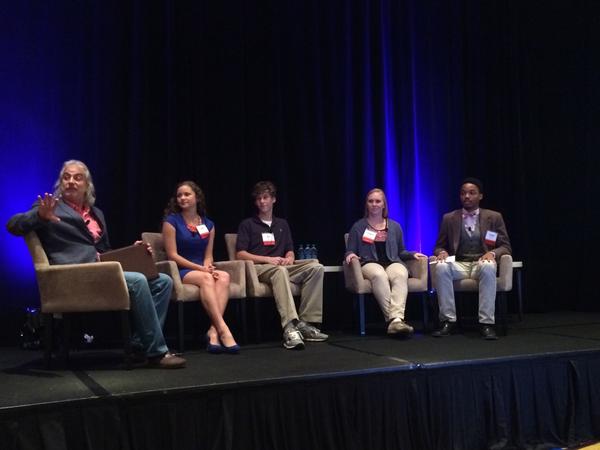
Throughout the conference, I kept connecting this work – windows and mirrors as a means of celebrating who students are and who they may become – with last week’s discussion of student voice. Students not only want to be heard; they want to see themselves in the curriculum and pedagogy. 

Monday, October 6, 2014

The Voice - Student Edition

Relationships matter. Teachers who care about their students matter. Being heard matters. Multiple ways to show learning matters.

At last week’s EdLeader21, Dr. Russ Quaglia facilitated a student voice panel. When he was concluding the session, four young Georgia students shared those statements in response to what mattered most. It wasn’t the first time they said that. Throughout the 45 minute panel, their message about what was most important in education was simple and clear: YOU. Again and again, students wanted their teachers to hear these three things: 1. I matter. 2. We matter. 3. You matter.

The research backs this up. If you know your students hopes and dreams, they are 18X more likely to be academically motivated. A simple survey at the beginning of a course can help teachers know about their students. One student shared a creative way that his teacher got to know them, a brilliant question: “How would what you are striving to be help us in a zombie apocalypse?” 

Students know when a teacher KNOWS them. They like hearing their names and having genuine conversations with their teachers.  Students believe they have something to teach us.  Students want to know WHY teachers teach. They believe if teaching is a passion, then it is no longer a job.

And while all of this was affirming, enlightening, and just an all-around great reminder, it was just one part of the bigger message. We need to hear our students. Students need to be invited to share their insights. One participant reminded us, “The past 200 years, ADULTS created the very best schools we know how. Would it be totally crazy to ask students what they think?”

Students should be participating colleagues in our work. Our friends in Farmington, MN include students in their Instructional Rounds. They ask students what they see and what works for them. The students’ points of view offer meaningful feedback. And it’s powerful for students to see their teachers being vulnerable and open to feedback to improve.

How we invite students to share can and should be decided locally – at the classroom level, at the building level, and ultimately systemically. Students are not just the consumers or customers of education; they are our reason for being. They should be our partners.

The final thought from the student panel was this:  just know me and let me know you. This will help me grow.


Tuesday, September 30, 2014

Networking


Legislators – at all levels – are notorious for mandates that are unfunded and ill-defined. While at a first blush, this can be frustrating, it is also liberating. We, at our district and site levels, have the opportunity to shape implementation of these mandates to meet the needs of our communities. And it is a lot of work. Just as we want our students to collaborate with their peers to meet real world challenges, so should we.

This week was all about networking: Q-Comp Leadership Network, Teacher Development and Evaluation (TDE) Community of Practice, and the District 287 Teaching and Learning Network. Internally we networked this week as well when we brought together our Innovation Coaches from each site, our parent representatives, and representatives from the Minnetonka Foundation. In all of these instances I walked out with greater clarity around my next steps, and possibilities for improving processes.

Student learning goals are one component of teachers’ evaluation in the recently enacted teacher evaluation law. At the Q-Comp Leadership Network, my colleague from Edina shared the rubric that they are using to evaluate teachers’ student learning goals. Rather than focusing on just the results, they will take into consideration the implementation of the strategies being used to meet the goal as well as reflections on the implementation. By including both the implementation of and reflections on the learning, they are recognizing the complexity of student learning. Similarly, at the TDE Community of Practice, my colleague from Anoka Hennepin shared a rubric that they are using to evaluate student learning goals as well. They, too, recognize and value that goal setting has many facets. Principals will consider five components of the student learning goal: determining needs, creating goals, planning instructional strategies to meet the goal, monitoring student progress, and reflecting on the goal. These two rubrics will be great conversation starters when our TDE committee meets again in November.

It’s also been pretty awesome to watch the internal networking of our Innovation Coaches. After some initial brainstorming in person, the conversation around our innovation efforts has continued in their Schoology group. They’re having fun as they decide how to further the culture of innovation in Minnetonka.


Every meeting we attend is an opportunity for different experiences to collide. As our networks expand, so do our perspectives.  And our loads are a little lighter as a result. 

Sunday, September 21, 2014

Moths and Cockroaches

On the way home from work the other day, I caught the tail end of an interview on NPR. The interviewee was discussing moths and cockroaches. Curious about the context of this topic, I tuned in. He was saying that moths fly to the light while cockroaches scurry from the light and look for dark places. It turns out that he was discussing stage actors. The interviewee believed that actors tend to be one or the other. He, as the director or teacher (I never did find out which), sometimes had to literally move an actor into the spotlight. It was the only way an actor could become the lead. And it started me thinking: is this true in all walks of life? Are we either moths or a cockroaches? Are we instinctually drawn to either light or darkness? And can a cockroach become a moth?

I think we all know individuals who tend to be attracted to possibilities. They have an aura of optimism. Their glasses tend to have a rosy tint. And, when their idealism is tempered with realism, they attract others to them.

On the contrary, we probably also know individuals who dash into dark corners when the spotlight shines. They congregate and multiply. And, as is true for the cockroach, the attraction to darkness is a survival mechanism. In the light they are vulnerable and exposed. Simply shining more and brighter light makes them retreat faster. Perhaps dimming the light, and understanding the fears that are sending them into sinister places, will make the world more hospitable.


Sunday, September 7, 2014

How is "Establishing a Culture of Learning" like a refrigerator? 

During Minnetonka Public Schools’ New Teacher Orientation, I asked teachers to compare this Charlotte Danielson concept to an appliance. The one that stayed with me was an analogy of buying a refrigerator. The teachers explained that taking the time to set up expectations at the beginning of the year was like investing in a top-of-the-line refrigerator. It’s expensive. And worth it. Everything has a place and gets the treatment it needs to stay fresh. It doesn’t take long, in a bad refrigerator, for things to start to stink and pretty soon you’re spending time with the repairman. In the end, it’s more expensive and is wasteful.

As teachers, we know the importance of setting up expectations for our kids on that first day of class. Equally important is taking the time to set up expectations for adult behavior when working in teams or committees. It can be tempting to simply adopt norms from previous years or committees. The danger is that there isn’t any ownership.

Learning Forward, the National Staff Development Council, suggests two means of creating norms (Richardson, 1999). The first is documenting current practices. Of course this suggests that the current practices are working! The second method is for each member to submit ideal behaviors for the group. While it is tempting to list behaviors that disrupt meetings, it is far better to identify behaviors to embrace than to identify behaviors to avoid.

Setting the norms is the easy part. Enforcing them is the challenge. Kathryn Blumsack, an educational consultant from Maryland who specializes in team development, said, “If you don’t call attention to the fact that a norm has been violated, in effect you’re creating a second set of norms. For example, a common norm is expecting everyone to be on time. If you don’t point out when someone violates that norm, then, in effect, you’re saying that it’s really not important to be on time.” Finding a way to do this in light, humorous ways is far preferable than shaming. You’ll need a norm around this as well.

Invest in the top-of-the-line refrigerator. Establish the culture for learning in your teams.

Richardson, Joan. Norms put the ‘Golden Rule’ into practice. Tools for Schools, August/September 1999.


Sunday, August 3, 2014

The Diamond Ring of Instruction: Student Engagement


Think about times when you were most engaged in a conversation, in a class, in a book, or in a movie. I bet you can remember it well. When we’re actively engaged, we learn and remember. The Minnesota legislature recognized the importance of engagement when it passed its teacher evaluation law in a special session in 2011. All teachers will now be evaluated not only on their skills in the classroom and on the achievement of their students, but also on the engagement of those students.  What leads to engagement? According to Dr. Robert Marzano’s meta-analysis, when students answer in the affirmative to these questions, they are most likely to be engaged in learning:
·         How do I feel?
·         Am I interested?
·         Is it important?
·         Can I do it?
In the 2013-14 school year, teachers in the Minnetonka Public School District learned teaching strategies to specifically address these questions.
The first two questions refer to attention-getting strategies. The core of how a student feels is the relationship the students feel with the teacher and their classmates and how they feel about the class itself. Humor, pacing, intensity and enthusiasm, and physical movement all have the potential to impact how a student feels in class. Interest can be increased through games, friendly controversy, unusual information, and questioning techniques.
The latter questions lead to cognitive engagement.  Students will believe that the learning is important when it is relevant to their own interests, when they have ownership of the learning through choice, and when they can see its relevance to other subjects or the real-world. Finally, students need to believe that they can be successful. If a student’s answer to “Can I do this?” is “No,” Dr. Marzano suggests that “students might lessen or abort their involvement – even if they have positive feelings about the task, are interested in the topic, and perceive it as related to their personal goals” (Marzano, 2013). Students need to believe that there is a correlation between effort and achievement.
The real challenge with the new requirement in the teacher evaluation law is not how to create engagement; it’s how to measure it. A student could be staring out the window, seemingly disengaged while actually deep in thought about a topic. Another student could be giving all of the right body language, smiling, nodding, and looking at the speaker, all while planning what she’s going to wear to the football game. And engagement looks different in PE than in English lit, and it looks different in kindergarten than 11th grade. A one-size-fits-all measurement won’t work.
To accommodate different subjects, different age groups, different job roles, the Minnetonka Teacher Evaluation Team created multiple paths for measuring student engagement. The first path teachers could consider is using the third-party survey that the District has purchased. Or a teacher could choose to create and deploy a survey of their own making. Another option is for teachers to use the Marzano self-assessments on student engagement. Or teachers can create their own plan for studying their students’ engagement.

Measuring anything as abstract as engagement is complex. A single snaphsot is unlikely to reveal the entire picture. And it's a starting place.